Home / Applications
Applications
Four products, and a fair amount of overlap between them. This page is arranged by department rather than by product, so you can find your own situation and see what fits it — including the cases where the answer is "none of these".
Critical care
Two different problems sit side by side here — fluid going in cold, and the air in a room that cannot be closed for cleaning.
Long stays, continuous infusion, and patients whose thermoregulation is already compromised. Cold fluid entering the line pulls core temperature down at exactly the moment the body can least afford it.
A neonate has very little thermal reserve and a high surface-area-to-mass ratio. Warming fluid before it goes in is not a comfort measure here.
Irrigation volumes during a long procedure are substantial, and an open cavity loses heat quickly. Air quality matters at the same time, and the theatre cannot be shut for fumigation between lists.
Unpredictable timing, so warmed stock has to be standing ready rather than prepared on demand.
Infection control
Fumigation needs an empty room and hours of downtime. These are the places where neither is available.
Large areas of compromised skin barrier, long admissions, and a high dressing-change frequency. Airborne particulate is a direct clinical risk.
Long sessions, immunocompromised patients, several at once in one hall. A single unit covering 2,500 cu ft usually serves the room.
Small, used all day, rarely cleaned between patients beyond the surfaces. A floor-standing unit that moves between rooms earns its keep here.
Laboratory and pharmacy
A different requirement: here the air has to be clean at the point the work is happening, which is a cabinet problem rather than a room problem.
Sterile compounding needs clean air over the work surface, not clean air in the room. ISO 14644-1 Class 5 within the cabinet is the standard usually asked for.
Contamination costs an entire run, not a single sample, so the cost of the cabinet is rarely the deciding factor.
The rest of the hospital
Departments that rarely get infection-control spending, but move the most people through the building.
Large volumes, long occupancy. Coverage is the constraint — size by room volume, not by bed count.
Odour and airborne load together. The activated carbon stage in the steriliser does the first job while the HEPA and UV-C do the second.
Aerosol-generating by nature, in a small room, with the next patient waiting. A contained UV-C unit running continuously suits the space.
Quick answer
| What you need · what to ask for | |
|---|---|
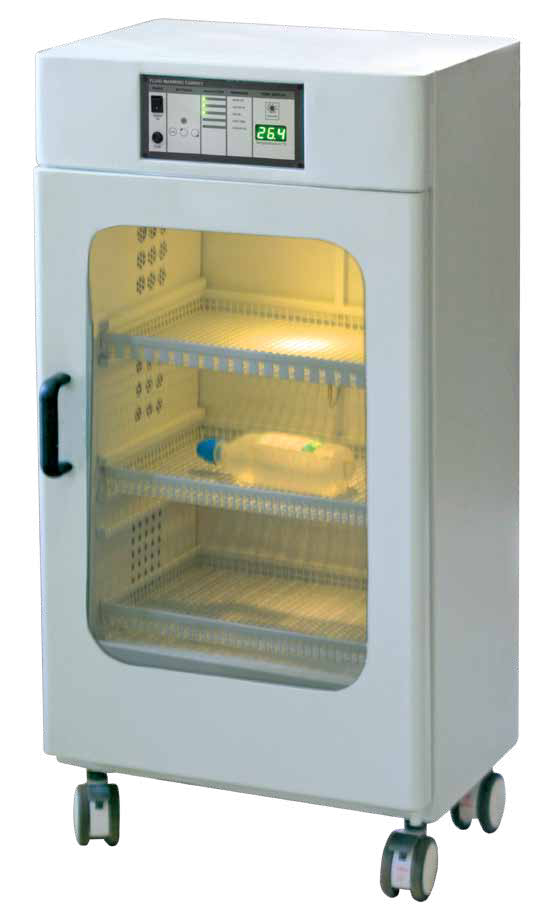
| IV fluids at body temperature, ready to use | Fluid Warming Cabinet · AAS-FWC-12 |
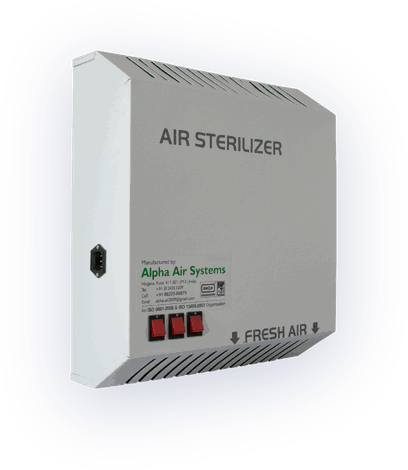
| Clean the air in a large room, continuously, while it is in use | Alpha Air Sterilizer · AAS-AS-60 |
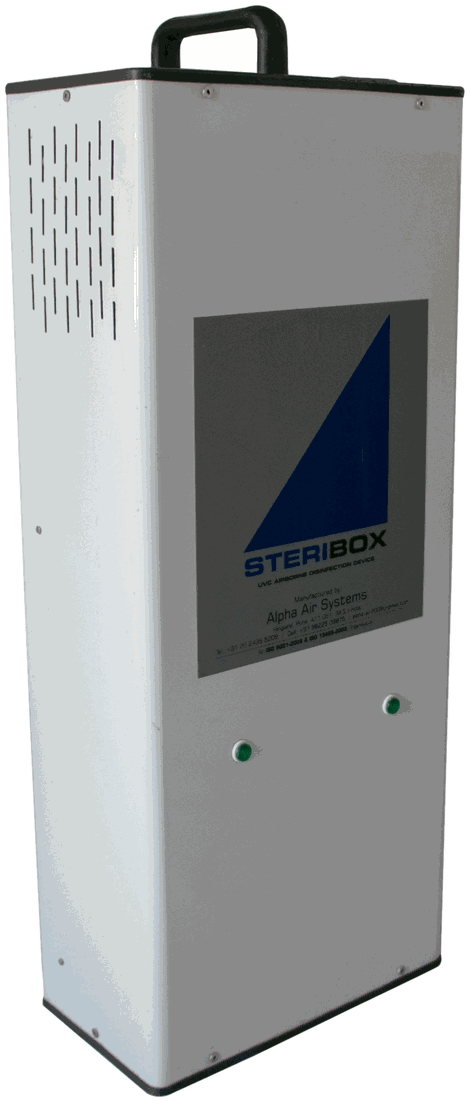
| Treat the air in one small room, move it between rooms | Steribox · AAS-SB-25 |
| Clean air over a work surface — compounding, plating, culture | Vertical Laminar Air Flow · AAS-VLAF |
| Keep an existing steriliser performing | Filter set · AAS-FS-3, once a year |
| Protect the operator from infectious or hazardous material | Not us — you need a biosafety cabinet |
The range
Tell us the quantity and the department it is for. Quotes usually go out the same working day, and we will say plainly what the delivery time is.